
Five years ago, the changing robe was a piece of kit you saw only in the back of a surf van: a heavy, hooded coat that a wetsuit wearer pulled on over wet neoprene before stepping out into the rain. Today it hangs in the wardrobes of open water swimmers, paddleboarders, triathletes, wild campers, festival goers, dog walkers and, increasingly, people who simply commute by bike in a wet climate. The category has gone from niche accessory to a genuine apparel segment, and the reason is not fashion. It is physics, a small, well-understood set of heat loss mechanisms that a properly built waterproof changing robe happens to interrupt at exactly the right moment.
This release sets out why the category grew, what the fabric actually does, where the design details matter, and how a buyer or a brand can tell a real waterproof robe from a towel poncho with a logo stitched onto it.
Why the category grew so quickly
Three trends converged. First, participation in cold and open water swimming expanded sharply after 2020, and it brought with it a large population of people who get changed outdoors, in wind, all year round. Second, paddleboarding and casual kayaking moved from specialist hobby to weekend activity, adding millions of occasional users who need warm, private changing space but will not buy a wetsuit. Third, outdoor clothing as a whole shifted toward what the trade now calls transitional layering: garments designed for the twenty minutes before and after the main activity rather than for the activity itself. The changing robe sits precisely in that gap. It is, in effect, a wearable shelter.
Social media accelerated what the product category had already earned. Short videos of swimmers emerging from cold water, pulling on a robe and visibly stopping shivering within a minute do more for demand than any advertising. In several markets the leading brand name has become a generic verb, which is the clearest possible signal that a category has crossed into mainstream awareness.
The science: why wet plus wind is so much worse than cold
The reason a changing robe matters is not comfort. It is thermoregulation. When skin is wet, water evaporates from the body surface and takes latent heat with it. Air movement multiplies the effect: a modest breeze at 10 degrees Celsius can strip heat from wet skin at a rate comparable to still air several degrees colder. Add vasoconstriction, the narrowing of surface blood vessels in response to cold, and the body loses its main defence at exactly the moment it needs it.
The more interesting problem comes after the swim. Core temperature frequently continues to fall for several minutes after a swimmer leaves cold water, a phenomenon known in cold water research as afterdrop. Cold blood from the limbs and skin returns to the core, and evaporative and convective losses continue while the swimmer stands around talking. This is why the ten minutes immediately after the activity matter more than most people assume, and why a wet towel poncho, which conducts and evaporates, can be worse than nothing at all.
A correctly specified waterproof changing robe addresses both stages. The shell stops wind and rain, removing convective loss. The waterproof membrane stops external water reaching the lining, so the inner layer stays dry and does not become an evaporation engine. The insulating lining traps a layer of still air next to the skin or over a wetsuit. And the loose cut allows a wearer to change inside the garment without exposing skin to the weather at all.
What the fabric is doing
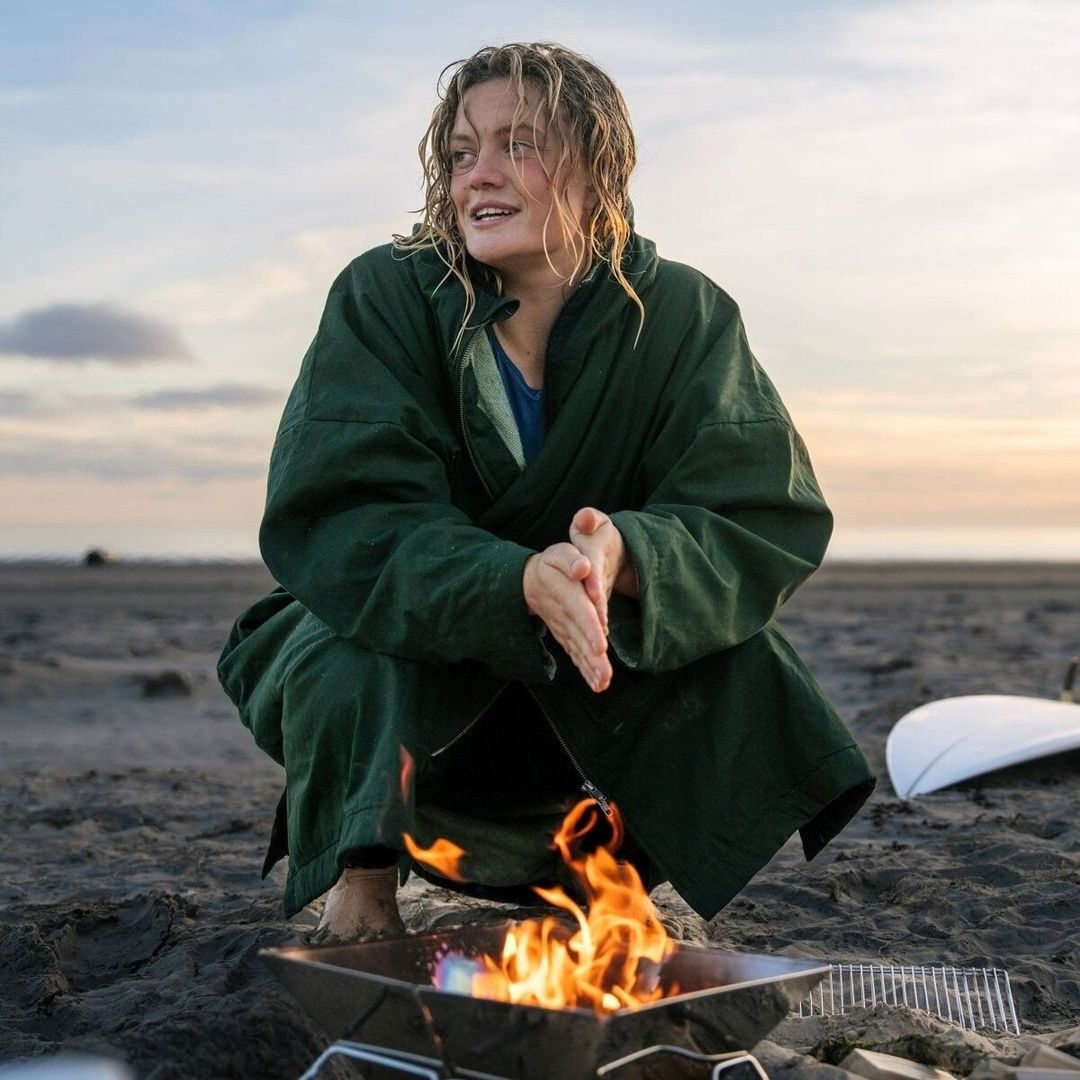
A serious robe is a three-layer laminate, not a coated shell. The outer face is a durable polyester or recycled polyester woven, finished with a fluorocarbon-free durable water repellent so rain beads and rolls rather than wets out. Behind it sits a membrane, usually polyurethane or a TPU film, sometimes an ePTFE, whose job is to block liquid water while allowing water vapour to pass. Behind that, a light knit or tricot backing protects the membrane and carries the lining.
Two numbers govern the specification. Hydrostatic head, expressed in millimetres, describes how much water column pressure the fabric resists before leaking; a robe for standing in rain or sitting on wet grass needs a meaningful figure, and every seam must be taped to match it, because an untaped seam will fail long before the fabric does. Moisture vapour transmission, often given as a RET value or in grams per square metre per day, describes how quickly sweat vapour escapes. A robe with excellent waterproofing and poor breathability turns into a condensation chamber during active use, fine for a two-minute change, uncomfortable for a forty-minute wait at a junior race.
Two further points separate good product from average. First, a durable water repellent that is PFAS-free: restricted fluorinated chemistry is being phased out across major markets, and a robe bought today should not depend on it. Second, a lining that stays effective when damp. Microfleece and sherpa both trap air well; borg fleece is warmer but bulkier; a brushed synthetic lining dries faster and packs smaller.
Design details that decide whether it works
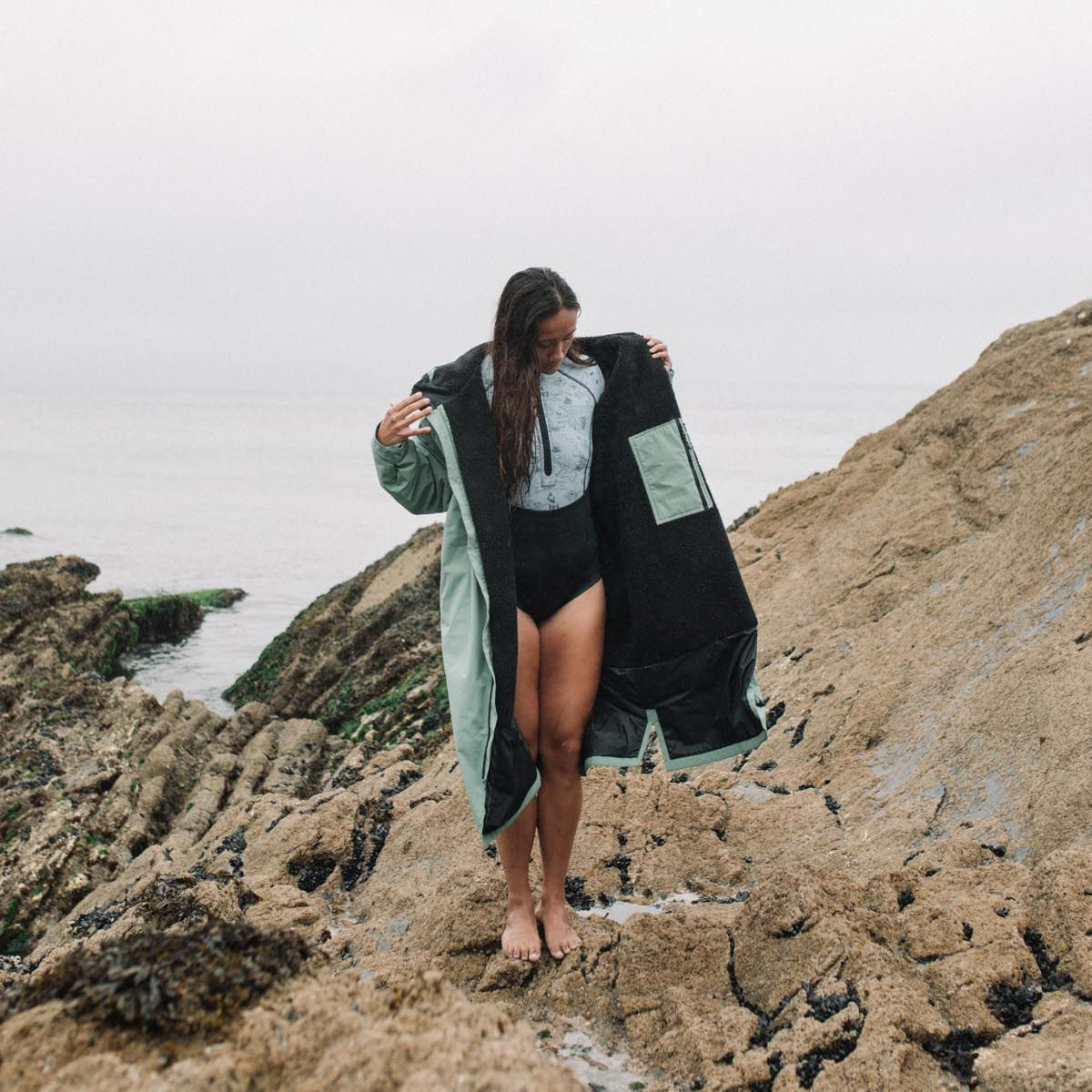
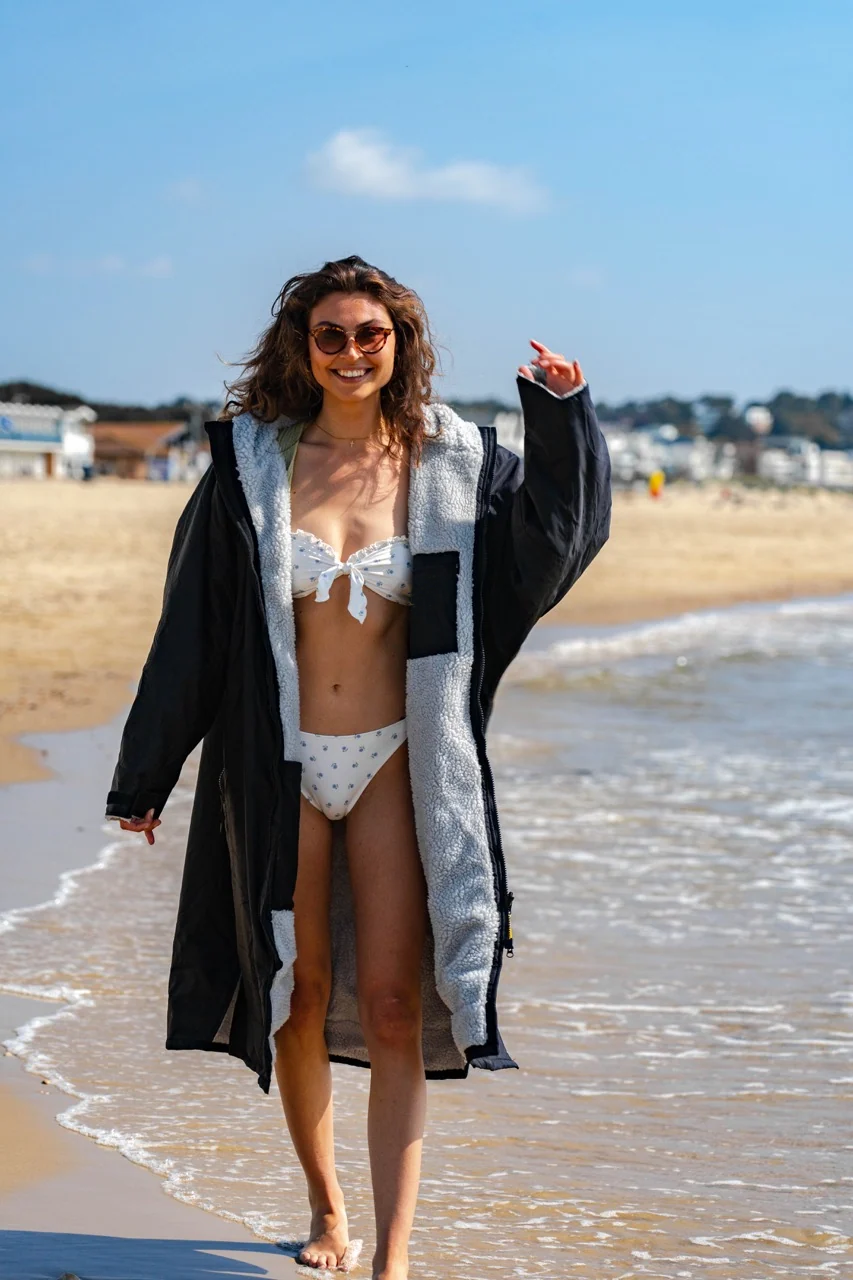
Sleeves rather than a sleeveless poncho, because arms are where wind chill is felt first and where changing actually happens. A two-way full-length zip, so the robe can be opened from below while the top stays closed against rain, and closed from the top while the hem stays clear of wet ground. An oversized, unisex cut with enough room to pull a wetsuit down to the waist inside the garment. A hood that adjusts rather than flaps. Cuffs that can be tightened. Pockets placed high and closed, because the things people carry, phone, keys, car fob, are usually wet-handed. And a weight and pack size that make the robe worth carrying, since a robe left in the van protects nobody.
Beyond the beach
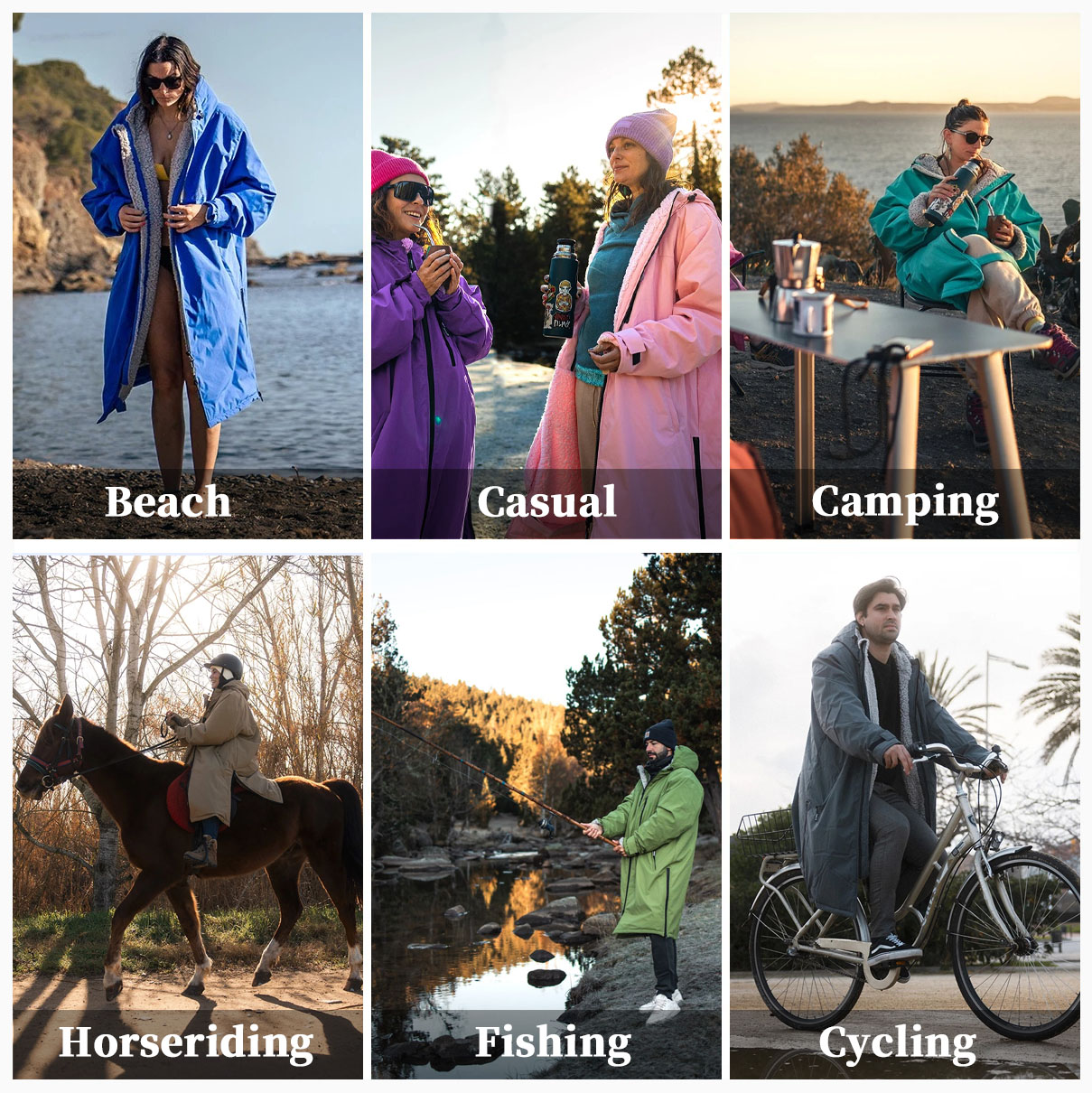
The category’s growth has been driven by watersports, but its usage has spread well past them. Changing robes now appear at campsites as a warm outer layer for the walk to the shower block, at festivals as rain protection over a costume, at equestrian events between classes, at amateur football and rugby touchlines, and on early dog walks. Triathletes use them in transition. Photographers use them to stay functional in bad weather. The common thread is not water. It is a need to stay warm and dry while doing something unglamorous outdoors, often while standing still.
Junior swimmers have become the fastest growing slice of that demand. Parents standing at a lake edge in October, holding a towel and a spare set of clothes, are the reason China Dry Robes Kids sizing has moved from afterthought to a development line of its own, with shorter lengths, lighter linings and cuffs and hems that stay clear of small feet.
What buyers and brands should check
For a consumer, four questions resolve most of the market. Is the seam taped or merely stitched? Is the waterproof rating stated as a number, or hidden behind adjectives? Is the DWR PFAS-free? Is the lining specified by weight, not just described as fluffy? A robe that answers all four is a garment. A robe that answers none is a costume.
For a brand shortlisting a Poncho Robe Supplier, the checklist moves upstream: documented hydrostatic and breathability test reports per production lot, seam tape adhesion checks after wash cycles, colour fastness on dark shades that will be worn over wet neoprene, and chemistry compliance with REACH and the relevant restricted substance lists in the destination market. Reproducibility matters more than a single good sample, because the failure mode in this category is not a bad first shipment. It is a second shipment that quietly drops from a laminated membrane to a coating.
Custom projects and supply
Our waterproof changing robe series is open for custom projects. We offer flexible development on sizing, length, lining fabrics, colour schemes, artwork printing, woven labels, hang tags and packaging. Core performance features including taped seams, PFAS-free DWR and two-way zips can be adjusted to match your target market requirements.
We serve wholesale distributors and private-label brands, supporting both OEM and ODM. Every production batch comes with complete test documentation for compliance verification.
To discuss custom specifications, request samples or technical files, contact us at sales@goodlifetextile.com.
Based in Huai’an, we work as a Dry Robe Manufacturer focused on outdoor and beach textile goods, including changing robes, hooded ponchos, bathrobes and beach towels for watersport, swim and hospitality markets.
(The image is from the Internet. If there is any infringement, please contact us to delete it.)
Post time: Nov-20-2026