
As the European Union tightens ecodesign rules and microplastic concerns reshape textile purchasing, natural-fiber home textiles — biodegradable cotton towels above all — are moving from niche preference to mainstream necessity.
A quiet but decisive shift is underway in the global home-textile industry. After years in which “sustainable” was a marketing adjective, it has become a compliance imperative and a commercial advantage. Biodegradable cotton towels — towels made from unbleached, undyed or minimally finished natural cotton that returns to the earth without toxic residue — now sit at the center of a convergence between tightening regulation, accelerating consumer demand and genuine innovation in fiber chemistry. For manufacturers, retailers and hospitality buyers across the United States, Europe, Japan and Southeast Asia, the question is no longer whether to offer biodegradable cotton, but how quickly they can bring it to scale.
A Regulatory Tipping Point: Why This Is No Longer Optional
The clearest driver is policy. In 2024, the European Parliament approved the Ecodesign for Sustainable Products Regulation (ESPR, Regulation (EU) 2024/1781), a sweeping framework that embeds environmental considerations into product design across dozens of industries, including textiles. Under the new rules, products must meet minimum standards for durability, reparability, recyclability and energy efficiency. Among the most consequential measures, the destruction of unsold clothing, footwear and accessories will be banned in the European Union from 2026, and large companies will be required to disclose how many unsold items they discard each year and why.
Just as importantly, the ESPR explicitly targets the release of synthetic microfibers into the environment. Textiles are estimated to be the fourth-largest source of microplastic pollution within the EU, and the regulation calls for binding design requirements to reduce the shedding of synthetic fibers throughout their lifecycle. It also modulates extended producer responsibility (EPR) fees so that more sustainable textile design is rewarded economically. The message to the supply chain is unambiguous: products that shed plastic and cannot be recycled or returned to nature will be priced, and eventually designed, out of the European market.
Against this backdrop, cotton — a fiber that biodegrades rapidly and completely — offers a compliance path that synthetic blends cannot match. Data compiled by Cotton Incorporated underlines the point: unfinished cotton breaks down reliably across soil, freshwater and marine environments, losing more than 70 percent of its mass within a month under activated-sludge conditions, at rates comparable to natural oak leaves. Even with common textile treatments, cotton’s biodegradability remains intact, which is not the case for polyester and polyamide, whose microfiber fragmentation can persist in ecosystems for decades.

The Natural Advantage: A Fiber Built for the Circular Economy
The environmental argument for biodegradable cotton towels rests on the fiber itself. Unlike petroleum-derived synthetics, cotton is a annually renewable agricultural product. When a cotton towel reaches the end of its useful life, it can be composted, biodegraded in soil or water, or — increasingly — reclaimed through mechanical and chemical recycling into new yarn. This positions cotton uniquely within the circular-economy frameworks that regulators and brands are now adopting.
The advantages go beyond end-of-life. Consumers and hospitality buyers increasingly scrutinize the full lifecycle: organic or sustainably grown cotton reduces the use of pesticides and synthetic fertilizers; low-impact, water-saving dyeing reduces pollution at the mill stage; and natural fibers avoid the microplastic shedding that accompanies every machine wash of a synthetic towel. For hotels, spas, resorts and gyms — heavy-volume users of towels — switching to biodegradable cotton simultaneously reduces plastic microfibers in wastewater and strengthens their environmental reporting. A dedicated Sport Towel Factory serving gyms and fitness clubs, for instance, can now build its entire product line around certified natural cotton, delivering absorbency that survives daily laundering while giving active customers a genuinely earth-friendly choice. It is a rare case where sustainability, compliance and product performance align without compromise.
Market Signals: A Green Premium That Is Becoming Mainstream
Commercial data confirms that this is not merely a regulatory story. The market for eco-friendly and organic home textiles is expanding steadily across regions. The global organic bedding market was valued at approximately USD 649.8 million in 2024 and is projected to reach roughly USD 997.2 million by 2032, growing at a compound annual rate of about 5.5 percent, according to Data Bridge Market Research. Broader forecasts from Stratistics MRC place the global eco-friendly bedding market at USD 4.63 billion in 2026, rising to USD 8.52 billion by 2034 — a 7.9 percent CAGR.
Material-level data tells the same story. Organic cotton already accounts for about 62.7 percent of the organic bedding market, reflecting established supply chains, familiar certification systems and broad consumer awareness. Industry surveys indicate that a growing share of premium textile exports now contain organic or eco-certified fibers, and a significant proportion of manufacturers have adopted certifications such as GOTS (Global Organic Textile Standard), OEKO-TEX and GRS (Global Recycled Standard) — signals that buyers now treat as table stakes rather than differentiators.
This demand is visible across the towel segment specifically. Major producers, including Indian textile giants such as Welspun and Trident, have moved toward circular and recycled-cotton towel lines for retail partners, signaling that even volume-oriented manufacturers see sustainability as a growth channel. On the premium end, luxury brands are introducing zero-twist and low-twist constructions and emphasizing eco-friendly dyeing methods that cut water and chemical use — all while retaining the plush absorbency consumers expect. The same shift is reshaping adjacent categories: Towel Robe Factories and a Kids Bathrobe Factory now field growing inquiries from hotels, spas and family hospitality buyers who want robes and children’s bathrobes in the same biodegradable, certified cotton, extending the natural-fiber story from towels to the full bathing and lounging experience.
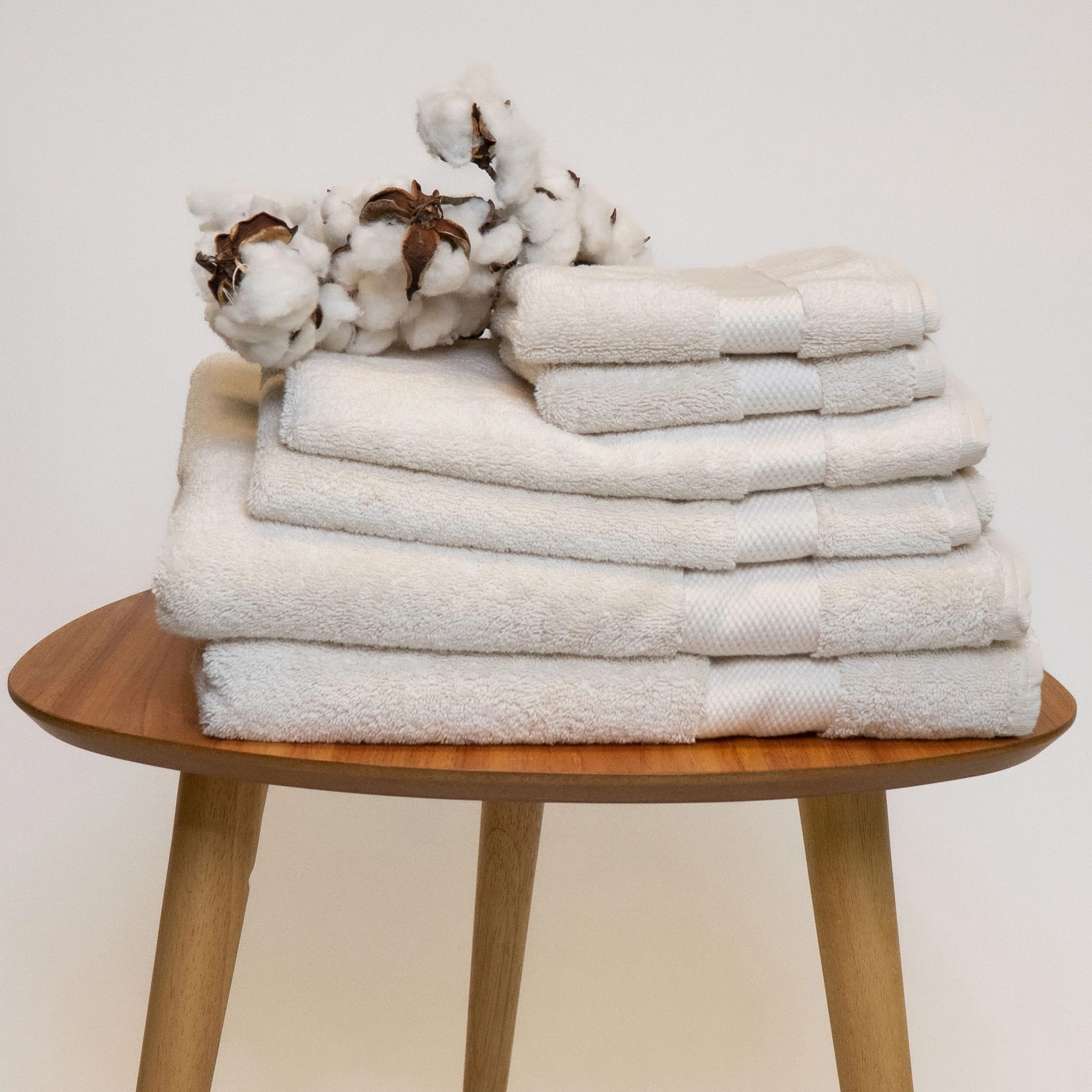
Innovation in Manufacturing: Making Biodegradable Practical at Scale
Meeting this demand requires more than marketing claims. The industry is investing in fiber chemistry and finishing technologies that preserve cotton’s natural biodegradability while delivering performance. Research highlighted by Cotton Incorporated is exploring cottonseed-oil-derived, bio-based finishing agents as replacements for formaldehyde-based resins and per- and polyfluoroalkyl substances (PFAS) — the “forever chemicals” now facing scrutiny and regulation. Bio-based finishes allow towels to remain naturally biodegradable after processing, solving what was once a tension between functionality and end-of-life.
In parallel, advances in textile recycling are expanding the pool of reclaimed cotton. Chemical-dissolution technologies, such as those commercialized by Renewcell and Evrnu, can dissolve cotton waste into virgin-quality fiber without pulping intermediates, enabling high-grade recycled cotton for towel yarns. The result is a fast-closing loop: cotton towels produced with certified organic or recycled fiber, finished with bio-based chemistry, laundered without shedding plastic, and composted or reclaimed at end of life.
Challenges and the Road Ahead
The transition is not without friction. Biodegradable and organic cotton generally carries a cost premium over conventional fiber, and supply of certified organic cotton is still limited relative to global towel demand. Recycled-cotton yarn can face quality and consistency hurdles in high-pile towel constructions, and buyers must guard against “greenwashing” — vague claims of biodegradability that lack third-party certification or clear disposal pathways.
Nevertheless, the direction of travel is clear. As the EU’s ecodesign regime takes full effect, as additional jurisdictions — from the United States to Southeast Asia — consider similar microplastic and textile-waste measures, and as eco-conscious consumers and corporate procurement teams align their purchasing with climate commitments, biodegradable cotton towels are positioned to become a defining product category of the coming decade. For manufacturers with GOTS and OEKO-TEX-certified supply chains, and for buyers who understand that a towel’s environmental footprint is shaped from field to landfill, the strategic choice is increasingly simple: embrace natural, biodegradable fiber now, or pay the regulatory and reputational cost later.
In the global sustainability transition reshaping the textile industry, few products connect policy, planet and profit as directly as the biodegradable cotton towel. It is biodegradable, it is renewable, it is certified, and it delivers the comfort consumers refuse to give up. As one industry observer put it, the future of the towel is the one that goes back to the earth.
(The materials are from the Internet. If there is any infringement, please contact us for deletion)
Post time: Oct-20-2026